 Let's chat
We've placed over 50 designers across five years. Three out of four engagements extend. This is the operating system behind every Forge contractor engagement: 8 stages, 12-week blocks, a level framework, feedback SLAs, and one front door.

A few years ago we had six senior designers embedded across four product lines at a single client. Design systems, consumer, enterprise, hardware. L6 and L7 ICs working on some of the most complex problems in the org.
We already knew 12-week engagement blocks made sense. That came from years of hiring contractors and agencies ourselves, long before Forge existed. Month-to-month never worked. Too short for real work, too ambiguous for procurement, too easy for both sides to avoid the hard conversations about whether an engagement should continue.
What we didn't have yet was a system. We had a loose playbook and a lot of instincts. That engagement forced us to formalize everything. The client had a head of design operations who ran a tight ship, very organized, very clear about expectations. Working alongside that kind of operational rigor taught us a lot. We added level mapping. We wrote policy and process documentation. We drafted candidate outreach templates for product designers, user researchers, and content strategists. We documented plays for situations we'd seen go wrong.
About a year in, we turned the whole thing into a Notion playbook. Then we made it a requirement. Before any recruiting or staffing begins, stakeholders sit down with the playbook, fill in the variables for their org, do the level mapping exercise, and tweak the policies to align with their internal standards. Every hiring manager bringing a role to us walks through it. They fill out the details, we talk about what they need, then we start the paperwork.
The teams that engage with the playbook end up being high-quality, long-term relationships. The ones that try to skip it and wing everything run into problems that the playbook was built to prevent.
We've now published the full thing as a free Notion template. This post walks through how it works.
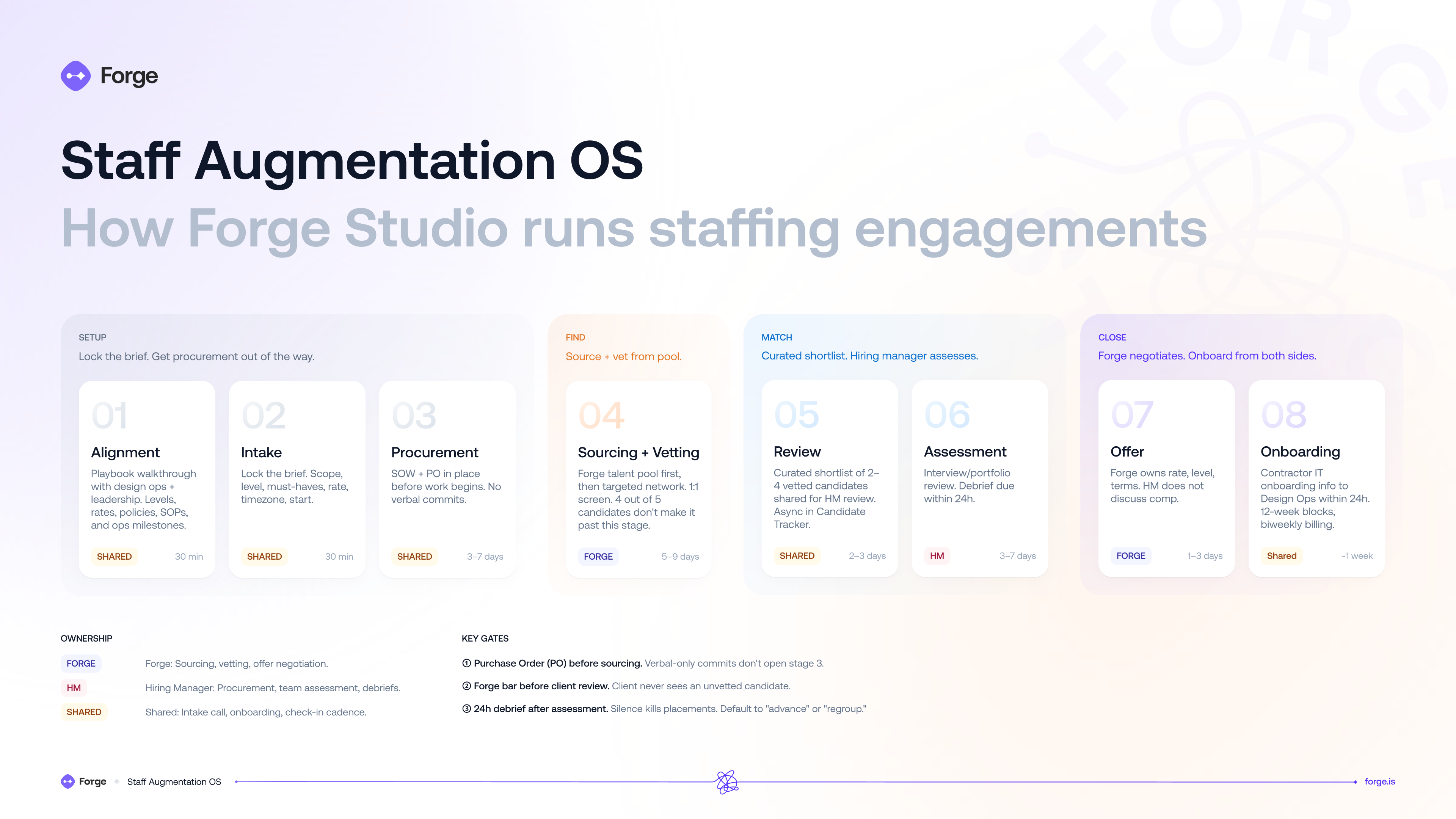
Every Forge engagement follows the same eight stages. Each one has a clear owner, a typical duration, and a gate that has to clear before the next stage starts. The gates are the point. Skipping them is how programs break.
1. Alignment session (Forge + Design Leadership + Design Ops). Before any roles are opened, we sit down with design leadership and design ops and walk through the playbook together. Levels get mapped. Rates get aligned. We agree on the extension decision window, the interview process, and conversion terms. The SOPs get tweaked to fit the client's internal policies. By the time a hiring manager brings a role to intake, the operating agreement is already in place. Nobody is negotiating the rules mid-engagement.
2. Intake (Forge + Hiring Manager, 30 minutes). We sit down and align on the role: level, domain, team context, tools, duration, start date. The output is a locked brief. Nothing moves forward until the brief is locked. This prevents the most expensive failure in staff aug, which is sourcing against a target that keeps moving.
3. Procurement (Hiring Manager, 1 to 3 weeks). The hiring manager secures a purchase order. We don't source against verbal commits. We've seen it too many times: sourcing completes, candidate is ready, procurement kills the req. That wastes the candidate's time, our time, and the hiring manager's credibility with their own team.
4. Sourcing + Vetting (Forge, 5 to 9 days). We source against the locked brief, starting with our Talent Pool. These are designers who have worked with us before or passed our screening. If the pool doesn't have a match, we source externally. Every candidate gets a 1:1 with Forge. The portfolio is what gets someone a conversation. From there we're looking at companies, teams, roles, what features they shipped, how they handled difficult situations, and whether the work was successful for the user, the business, and the team. About 4 out of 5 candidates don't make it past this stage.
5. Candidate review (Forge to Hiring Manager, 2 to 3 days). We present a curated shortlist. Two to four candidates, never more than five. Each one comes with our assessment: level recommendation, strengths, potential gaps, availability. This is not a volume dump.
6. Team assessment (Hiring Manager, 3 to 7 days). The hiring manager runs their internal evaluation. The gate here is the 24-hour debrief rule: within 24 hours of completing an assessment, the hiring manager provides a decision. Yes, no, or "let's regroup." Silence is the most expensive response in contractor hiring.
7. Offer (Forge, 1 to 3 days). We own the offer. We negotiate terms, confirm the rate, and close the candidate. The hiring manager doesn't discuss compensation with the candidate. This keeps things clean for both sides.
8. Onboarding + Shipping (Forge + Client, about 1 week). The contractor starts. Within 24 hours of day one, we deliver an onboarding data block to the client's design ops team: contact info, level, rate, engagement dates, escalation contacts, check-in cadence. 12-week engagement blocks. Biweekly billing. Extension decision by week 8.
Alignment to onboarding typically takes 4 to 8 weeks. The bottleneck is almost always procurement. The stages Forge controls take 5 to 12 business days combined.
Every engagement is structured in 12-week blocks with a one-block minimum. This was a day-one decision, not something we evolved into. It comes from years of experience on both sides of the table, hiring contractors and being the contractor.
Biweekly billing keeps us tightly bound to the block structure and the key milestones inside each block. It's also how we keep regular check-ins with design ops and managers grounded in real numbers. Everyone knows where budget utilization stands and how much runway is left.
The extension decision happens by the end of week 8. Not week 11, not "sometime before the block ends." Week 8. That gives both sides enough time to either plan the next block or plan a clean wind-down.
About three out of four engagements extend. The most common scenario is a hiring manager who brought someone on to backfill a parental leave, and when the employee returns, they wish they could keep the contractor or find another role for them. We've had teams come back a month or two after an engagement ends and re-engage with the same contractor, same team, same projects.
This is where hiring managers push back the most. Every org thinks their levels are tougher than everyone else's. "Your L5 is our L4." Sometimes that's true. Most of the time it isn't.
The framework runs L3 through L9. L3 is associate-level with solid craft who needs direction on ambiguity. L4 owns features end-to-end with light guidance. L5 is senior: runs a workstream, pushes back on briefs that don't make sense, mentors other designers. L6 is staff: operates across teams, shapes strategy. L7 and above are setting quality standards and defining how a design org thinks about its craft.
The mapping exercise happens before a single candidate is sourced. Thirty minutes. We sit down with the hiring manager and align frameworks. L5 at Forge maps to IC3 at your company, or Senior II, or whatever your internal titles are. The output is a shared document both sides reference throughout the engagement.
This is the single most effective hedge against the most common failure in staff aug: a hiring manager says "senior," the agency hears something different, and two weeks of sourcing go in the wrong direction. We'd rather spend 30 minutes calibrating than waste two weeks.
We also apply a specialist multiplier of 15% for designers with deep domain expertise. Healthcare regulatory, financial services compliance, accessibility engineering, design systems architecture at scale. The multiplier reflects sourcing difficulty and a smaller candidate pool. It's not arbitrary.
About a year ago, we had our first mislevelings. It happened because we rushed the process and skipped the calibration step. It was the first time in four years that a contractor engagement ended early. That experience reinforced what we already knew: the mapping exercise isn't optional, even when everyone is in a hurry.
Speed of feedback is the single biggest predictor of placement success in our data.
When feedback from a team assessment lags past 48 hours, placement rate drops by more than 30%. Past two weeks, the candidate is gone. They've taken another offer, they've cooled on the role, or they've made up a story about why you went silent that's worse than the truth.
So we built the program around it. Within two business days of receiving a shortlist, the hiring manager responds with a yes or no per candidate and provides three open 30-minute slots for team assessments. Within 24 hours of a team assessment, the hiring manager debriefs: yes on offer, no, or "let's regroup." For async requests during an active engagement, 48 hours.
These are not suggestions. They're the operating contract. We review SLA adherence at every transition review and flag patterns early. If a hiring manager can't debrief in 24 hours, the default should be "yes, advance" or "let's regroup." Never silence.
Forge is the contracting entity for every placement. The hiring manager owns the work. The contractor does the work. We own the relationship.
All comp negotiation goes through us. The hiring manager doesn't discuss rates with the candidate. All performance feedback goes through us. If a contractor is struggling, the program leader handles it privately, outside the engagement audience. We agree on a path: corrective plan with a two-week recheck, or a graceful exit. All escalations go through us. All conversions go through us. If you want to bring a contractor on full-time, you tell us first. Standard fee is 30% of first-year base.
This sounds like overhead. In practice it means the hiring manager doesn't have to be a procurement specialist, an HR partner, a legal advisor, or the person who has the tough conversation. They just manage the design work. Everything else is on us.
We published the entire Staff Aug OS as a free Notion template. The 8-stage process with owner assignments and gate definitions, the 12-week block structure, the full level framework with mapping exercise, feedback SLAs, the one-front-door model, and a checklist for standing up the program at your org.
No sales call. No email gate.
We published it because the baseline for running contractor programs is low, and a better playbook benefits everyone: hiring managers, contractors, and agencies. The teams that sit down and engage with a structured framework end up in better relationships. We've seen it over 50 placements across five years.
If you run a design team that uses contractors, take the template and make it yours. If you want Forge to run the program for you, that's there too.
We work with teams to deliver world-class digital experiences and transformative business outcomes. By conducting insightful research, intelligent product strategy, and exceptional design, we help you design and ship successful products from the start.

We take products from zero to one by establishing a product vision, exploring opportunities, and shipping a solution that resonates.
Our work
We can rearchitect your product for scale by being your experienced thought partners, helping you explore new opportunities for growth.
Our work
If your design team is spread too thin or you need help taking on new challenges, we can embed vetted, world-class talent into your team.
Learn more
Raise the product quality bar and enable accelerated time to market by investing in a flexible, scalable design system.
Learn more
We help you de-risk decisions, better understand your users, determine the competitive landscape, and empower your teams to deliver value.

Discover a compelling story and craft an effective marketing strategy that turns customers into your company's evangelists.